Amazon Omni Qled Tv 2025 vs Jbl Bar 1300Mk2 Review: Performance, Price, and Verdict
I've been living with the Amazon Omni QLED TV 2025 as my primary display and the JBL Bar 1300Mk2 as my main sound system for the past five months. I bought both to replace an older OLED TV and a cheap 2.1 soundbar because I wanted brighter HDR highlights for daytime viewing and a more immersive, room-filling sound for movies and games. After months of watching films, streaming series, playing fast-paced multiplayer games, and listening to music, here's a hands-on, honest comparison of how they perform together and separately — what I loved, what annoyed me, and who each product is actually for.
Introduction: Why I chose this combo
My living room gets a lot of natural light, so a bright QLED panel made sense. I also wanted better spatial audio than my previous bar could offer without committing to an entire surround-speaker ecosystem. The Amazon Omni QLED TV 2025 promised punchier HDR and an Alexa-integrated smart platform, while the JBL Bar 1300Mk2 positioned itself as a near-flagship soundbar with immersive Dolby Atmos-esque processing, a wireless sub, and optional wireless rears. In my experience, pairing a bright, colorful TV with a high-end soundbar is the most practical way to upgrade both picture and sound without the complexity of a full AV receiver setup.
Amazon Omni QLED TV 2025 — my experience
After using the Omni QLED daily—for TV shows, movies, and gaming—what stood out first was how lively the colors remained even during daylight. The QLED panel delivers saturated hues that make HDR content pop, particularly nature documentaries and animated films. Skin tones are generally natural, though you can push the color setting too far and end up with unrealistically vivid reds. I calibrated it down slightly from the default mode and saw immediate improvement.

Here are the things I noticed over several months:
- Brightness and HDR: The TV gets bright enough to cut through ambient light in my living room. HDR highlights feel impactful on content that’s mastered well. I appreciated the sustained highlights in scenes like sunlight on water and specular reflections in action films.
- Local dimming and blooming: Local dimming helps contrast, but it’s not perfect. On high-contrast scenes, I noticed occasional haloing around bright objects on dark backgrounds. It wasn't constant, but it was visible in scenes with small, bright details against a dark sky.
- Viewing angles: The panel is decent but not exceptional. If you sit off-axis (more than 30 degrees), contrast and color accuracy degrade noticeably. For a 65" living room setup optimized for center seating, this wasn't a dealbreaker, but it's something to consider if you host people frequently.
- Gaming: I used the TV for both a PS5 and a gaming PC. The input lag in Game Mode is competitive — I did not notice any perceptible delay in first-person shooters or fast racers. It supports variable refresh features that made a difference when toggled on.
- Smart platform and remote: The TV's built-in smart interface is convenient and integrates Alexa voice control well. That said, the interface sometimes feels cluttered with promoted content and app suggestions. The remote is lightweight and responsive, but I missed a more tactile volume wheel and found the voice button placement awkward at first.
- Build and design: The bezel is reasonably thin and the stand was sturdy. Mounting options are standard. The back panel houses multiple HDMI inputs including an eARC-compatible HDMI, which I used to connect the JBL bar.
Pros & Cons — Amazon Omni QLED TV 2025
- Pros:
- Bright QLED panel with punchy HDR highlights
- Accurate colors after light calibration
- Low input lag and gamer-friendly features
- Built-in Alexa and convenient smart features
- Cons:
- Local dimming can bloom around small highlights
- Viewing angles are limited compared to VA/IPS alternatives
- Smart UI has promotional clutter
- Stock calibration is too saturated for some content
JBL Bar 1300Mk2 — my experience
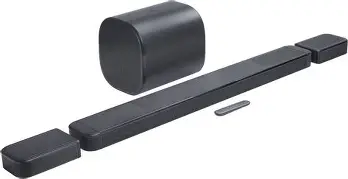
I paired the JBL Bar 1300Mk2 via HDMI eARC and optical when testing different devices. Right away, the bar changed the atmosphere in my living room: dialogue became clearer, and the low end had the physical presence my old bar lacked. I used the included wireless subwoofer and, at times, the optional wireless rear speakers to see how close the bar got to a full surround experience.
Key observations over months of use:
- Soundstage and immersion: The JBL Bar 1300Mk2 creates a surprisingly wide soundstage for a single-bar solution. On Atmos-encoded tracks and modern movie mixes, I detected convincing height cues and lateral movement. It's not identical to a dedicated multi-speaker Atmos setup, but it's the closest single-box solution I've lived with.
- Bass and impact: The wireless sub gives a physical thump without overpowering the mids. I appreciated how it handles transient bass — explosions and drum hits felt tight rather than muddy. On very low-frequency-heavy tracks, the sub reaches its limits but doesn't distort at sensible listening levels.
- Dialog clarity: Voices came through cleanly, which made late-night TV less fatiguing. The center focus is strong; I rarely had to raise the center channel EQ for theater dialogue.
- Music listening: I streamed Tidal and Spotify via Bluetooth and recommended codecs. The bar gets surprisingly musical — not audiophile-grade, but very pleasing for casual listening and background music.
- Setup & connectivity: Setup was straightforward: HDMI eARC carried Atmos/DTS content from the TV to the bar reliably. There were occasional hiccups with lip-sync out of the box, but adjusting the TV's audio delay solved it. Firmware updates added small improvements during my ownership.
- Limitations: In very large rooms the bar can feel short on headroom — pushing it hard introduces compression artifacts. Also, some advanced room correction features are absent compared to AV receivers, though the basic EQ modes are useful.
Pros & Cons — JBL Bar 1300Mk2
- Pros:
- Impressive virtual Atmos soundstage for a soundbar
- Strong dialogue clarity and balanced mids
- Wireless sub adds satisfying bass impact
- Easy setup and reliable connectivity (HDMI eARC)
- Cons:
- Not a full replacement for a high-end discrete surround system in very large rooms
- Some advanced tuning and room correction features are missing
- Can be compressed at max volumes
Side-by-side comparison
| Feature | Amazon Omni QLED TV 2025 | JBL Bar 1300Mk2 |
|---|---|---|
| Type | Smart QLED television (display) | Premium soundbar with wireless sub (audio) |
| Primary purpose | Picture quality, HDR, smart platform | Immersive audio, dialogue clarity, bass |
| Best for | Bright rooms, gaming, streaming video | Movies, TV shows, music, virtual surround |
| Connectivity | Multiple HDMI ports, eARC, Wi‑Fi, Bluetooth | HDMI eARC, optical, Bluetooth, Wi‑Fi for updates/streaming |
| Sound | Built-in TV speakers (adequate for casual listening) | Multi-driver soundbar + wireless sub; full, room-filling sound |
| Gaming features | Low input lag, VRR/ALLM support (Game Mode) | Low latency for audio, game EQ mode |
| Setup complexity | Plug-and-play; some UI tweaks recommended | Simple; pair sub & rears; calibrate lip-sync |
| Price (relative) | Mid to upper-mid for a QLED TV | Upper-mid to premium for a soundbar |
| Strength | Brightness and color pop | Immersive, clear, punchy sound |
| Weakness | Blooming/local dimming artifacts; viewing angles | Not a substitute for a dedicated multi-speaker system in large rooms |
How they work together (my combined setup)
Wiring the two together via HDMI eARC was straightforward and, in my experience, the best way to get Atmos or high-bitrate multichannel audio from streaming apps and newer game consoles. I set the TV to pass through bitstream audio to the soundbar, and enabled the bar's surround processing. The result was a much more cinematic experience than the TV speakers alone: action sequences felt punchier and dialogue sat in the center with more presence.
Shop the latest TVs & Home Theater picks on Amazon.
Shop Amazon →One small issue I encountered early on was lip-sync inconsistencies when switching between streaming apps and the PS5. After updating both firmware versions and fine-tuning the audio delay setting on the TV (adding 40–60 ms depending on the source), the sync matched perfectly in most content. Firmware updates during my ownership also helped stabilize connectivity and improved minor audio processing quirks.
Buying guide: Is this the right pairing for you?
When deciding whether to buy the Amazon Omni QLED TV 2025 and the JBL Bar 1300Mk2, consider the following questions — these are the same checkpoints I ran through before deciding to purchase and after living with them for months.
1. What’s your room like?
If your living room has bright windows or a lot of ambient light, a QLED panel like the Omni will deliver punchier HDR highlights than many OLEDs — at least in daytime viewing. However, if you want deep inky blacks and you mainly watch in the dark, an OLED or a TV with better local dimming may be preferable. For audio, the JBL bar works best in medium sized rooms; in very large rooms you may need additional rears or a separate subwoofer for the same impact.
2. Are you a gamer?
I used the TV extensively for gaming. If low input lag, VRR, and a responsive panel are priorities, the Omni QLED is a solid choice. Pairing it with the JBL bar gives you immediate, detailed sound without juggling multiple speakers. If you’re a competitive player who needs the absolute lowest latency audio setup, double-check manufacturer latency numbers and consider using optical or a direct headphone output for critical sessions.
3. How important is immersive audio?
If Atmos-like immersion without wiring a dozen speakers appeals to you, the JBL Bar 1300Mk2 delivers a convincing experience. It won't fully match a high-end discrete Dolby Atmos speaker array, but it’s considerably better than most built-in TV speakers and many lower-tier bars. If you care most about music fidelity at audiophile levels, look into a dedicated stereo setup instead.
4. Budget and upgrade path
This pairing sits in a mid-to-premium range overall. If your budget is limited, prioritize the TV if you mainly consume visual content, or the soundbar if you'd rather a much better audio experience first. The nice thing about this combo is upgrade flexibility: you can later add wireless rear speakers to the JBL or upgrade the TV's calibration via a cheap colorimeter and software tweak.
Discover deals on TVs & Home Theater — updated daily.
View Offers →5. Practical setup tips I learned
- Use HDMI eARC between TV and soundbar for the least hassle and best audio formats.
- Run a few firmware updates right away — both products received meaningful fixes during my ownership.
- Spend 30 minutes on the TV's picture mode and the soundbar's EQ settings; stock presets are rarely ideal.
- For lip-sync issues, adjust the TV audio delay in small increments rather than huge jumps.
- If you have a lot of reflective surfaces or hard floors, consider adding a rug or soft furnishings; they dramatically improve perceived bass and clarity.
Who should buy which product?
In my experience, the Amazon Omni QLED TV 2025 is a solid pick if you want a bright, colorful panel that performs well in daylight, with sensible gaming features and smart-home integration. If you host viewers who sit off-center often, consider testing viewing angles first.
The JBL Bar 1300Mk2 is a great buy if you want immersive, cinematic sound without the complexity of an AV receiver and discrete Atmos speakers. It’s particularly strong for film lovers who want better bass and spatial cues but don’t want to run wires around the room. If you live in a very large open-plan space and push very high volumes, you might find its limits sooner than in a standard living room.
Final verdict
After five months of daily use, here's my takeaway: the Amazon Omni QLED TV 2025 and the JBL Bar 1300Mk2 make a very successful living-room upgrade when paired together. The TV gives me bright, compelling HDR images that survive daytime viewing, and the JBL bar transforms those images into an engaging audio experience with clear dialogue, satisfying bass, and a wide soundstage.
What I appreciated most was how effortless the setup stayed after the initial tweaks — streaming, gaming, and switching sources all worked smoothly once I sorted out a small lip-sync setting. What bothered me were the predictable compromises: occasional blooming on the TV and the soundbar's limits at very high volumes in a large room. Neither of these are showstoppers for my daily use, but they are real and worth knowing before you buy.
If you want bright picture and near-flagship single-box audio without the fuss of a full surround system, this pairing impressed me enough to keep both in my living room. If ultimate black levels or the last 10% of soundstage realism are what you crave, you should compare other TVs and component speaker systems in person. For my mix of daytime viewing, streaming, gaming, and music listening, this combo hit the right balance of convenience, performance, and value.